Is the Mtentu Ramble Suitable for Beginners?
The Mtentu Ramble is a moderate 4-day coastal hike. Here is an honest guide to whether this trail is right for beginners and what to expect.
 Allan Hein11 June 2026
Over the years we've had hundreds of people walk this coastline with us. Some were experienced long-distance hikers who'd done the Otter Trail twice and the Drakensberg Grand Traverse. Others had never done an overnight hike in their lives. Both groups finished the Mtentu Ramble, and both groups said it was one of the best things they'd ever done.
The Short Answer
Yes. The Mtentu Ramble is a moderate 4-day guided hike, and it suits beginners. You walk 8 to 14 km a day on mostly flat coastal terrain, carry nothing heavier than a day pack, and sleep in a real bed every night. If you can walk 10 km on a Saturday without being wrecked on Sunday, you can do this trail.
What that tells you is that the trail is genuinely accessible. What it doesn't tell you is that it requires nothing of you. It does. Here's exactly what to expect.
Table of Contents
- The Short Answer
- What does the Mtentu Ramble involve?
- How many kilometres do you walk each day?
- Do you carry your own backpack?
- How fit do you need to be?
- Do you need hiking experience?
- What makes the Mtentu Ramble beginner-friendly?
- What is the hardest part of the trail?
- Do I need hiking boots or will trail runners do?
- How do you train for a multi-day hike?
- What do first-time hikers say?
- FAQs
What does the Mtentu Ramble involve?
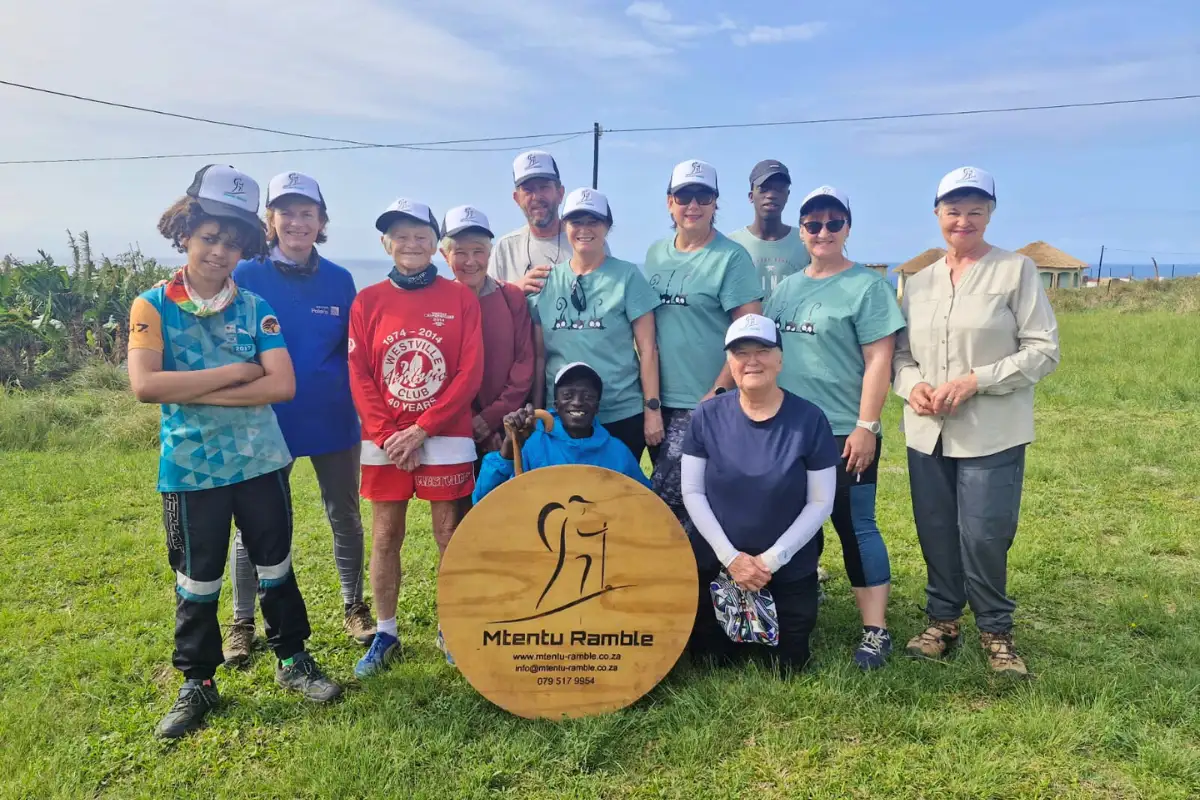
Hiking group posing around the Mtentu Ramble wooden sign on green coastal grassland, Wild Coast South Africa
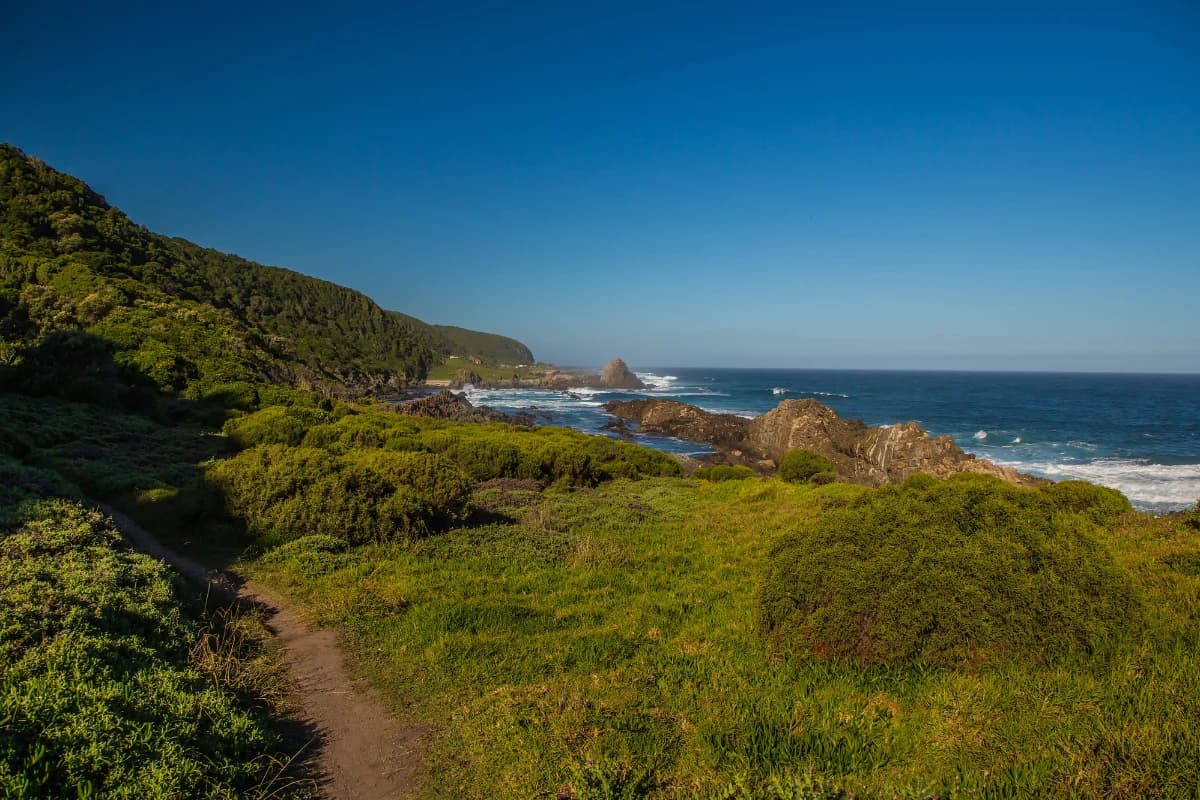
The Mtentu Ramble is a 4-day, 3-night guided hiking trail on the Wild Coast of South Africa. You start at the Wild Coast Sun and finish at Mtentu, covering 30+ km of coastal trail.
Each day you walk between 8 and 14 km, depending on the route and conditions. The terrain is a mix of beach walking, coastal grassland, some gentle hills, and river crossings, by kayak or on foot depending on water levels.
At the end of each day there's a proper bed, a hot meal, and a fire. Nothing is self-catered. Nothing is carried except your personal day pack. Your guide handles the rest.
Trail at a glance
- Duration: 4 days, 3 nights
- Distance: 30+ km total
- Daily distance: 8 to 14 km
- Difficulty rating: Moderate
- Terrain: Beach, coastal grassland, dune fields, river crossings
- Accommodation: Community homestays and trail lodges
- Catering: Fully all-inclusive
- Guides: Local guides included throughout
How many kilometres do you walk each day?
Between 8 and 14 km a day, for a total of 30+ km across the four days.
Day one is the shortest, which is deliberate: it lets people find their rhythm and their feet before anything demanding. Day three is usually the longest. Day four is a transfer day rather than a walking day, so you are not finishing on a hard march.
In practice that works out to roughly four to five hours of actual walking on a normal day. That is not four to five hours of relentless effort, though. It includes breaks, swims, time standing about looking at things, and a proper stop for lunch. Guests are often surprised how much of the day is spent not walking.
Do you carry your own backpack?
No. All you carry is a day pack with water, snacks, a camera, and a rain jacket.
Your main bag is transferred for you, and every meal and bed is arranged in advance. This is what is known as slackpacking, and it is a very large part of why this trail is manageable for people who have never done a multi-day hike before.
One detail to get right: the transferred bag goes straight to the Hiking Shack, where you sleep on nights two and three. It does not go to the first night's homestay, so your daypack needs to cover two days of walking and one night away from your main bag. Full detail in what to pack.
It changes the experience more than the numbers suggest. Walking 12 km with 4 kg on your back is a pleasant day out; walking the same 12 km with 18 kg of tent, food, and cooking gear is an entirely different sport. If you have looked at multi-day hikes before and quietly concluded they were not for you, this is usually the thing that was putting you off.
How fit do you need to be?
I'm not going to tell you this trail asks nothing of you physically. It does. Four days of walking in coastal terrain, with some days exceeding 12 km, requires a basic level of fitness that not everyone has sitting in the bank from their daily life.
What I can tell you honestly is this: you don't need to be a runner. You don't need a gym membership. You don't need to have ever worn hiking boots before. What you need is the ability to walk steadily for four to five hours on an active day, with breaks, without it destroying you.
A simple test: can you walk 10 km?
If you can walk 10 km on a Saturday without being wrecked for the rest of the weekend, you'll manage this trail comfortably. If 10 km on a Saturday would be a stretch, spend six weeks building up to it before you come.
The terrain helps. There are no high mountain passes, no scrambling, no altitude. The coast is mostly flat to gently rolling. The challenge is duration and the occasional soft sand beach section, not technical difficulty.
Do you need hiking experience?
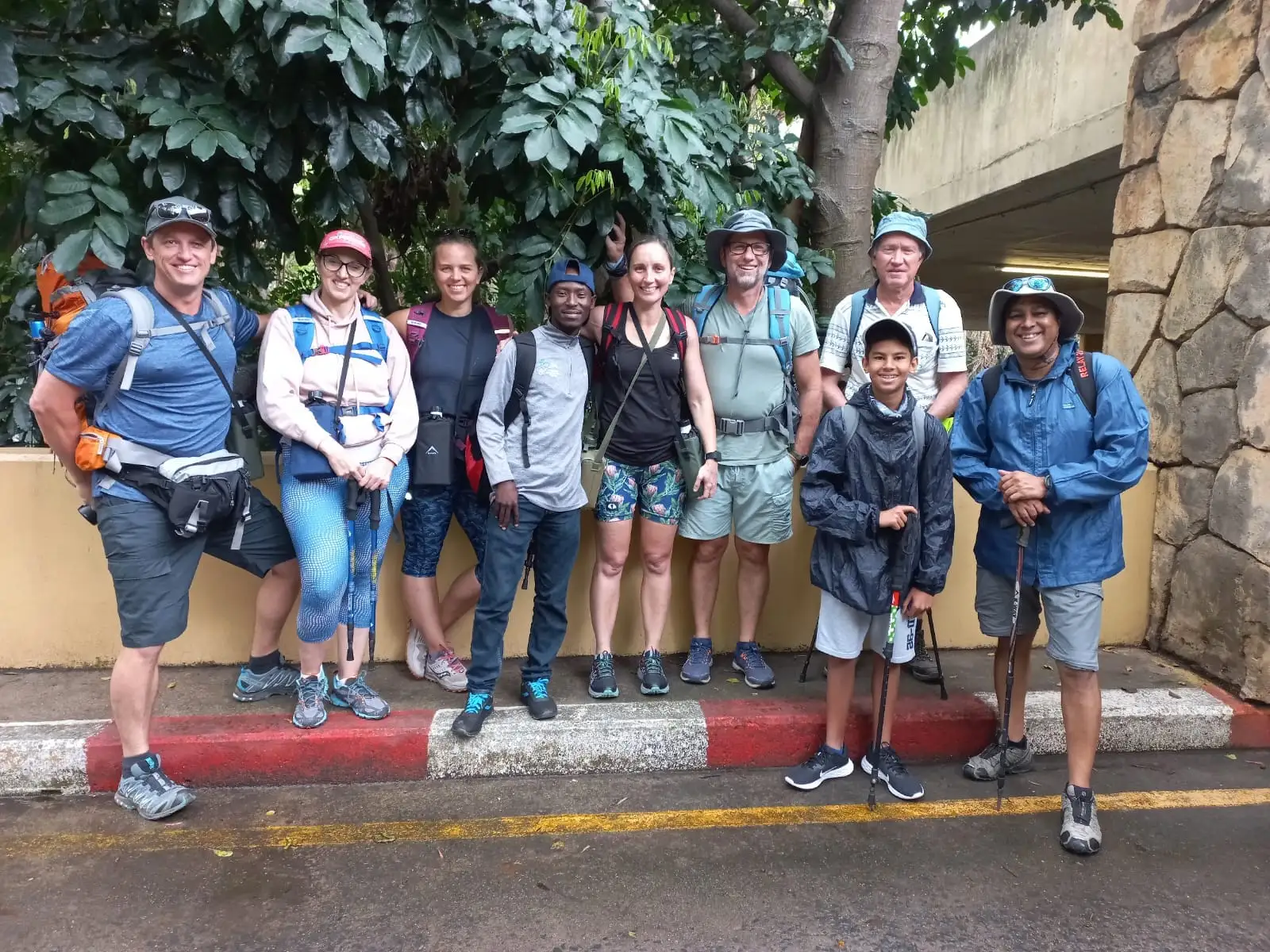
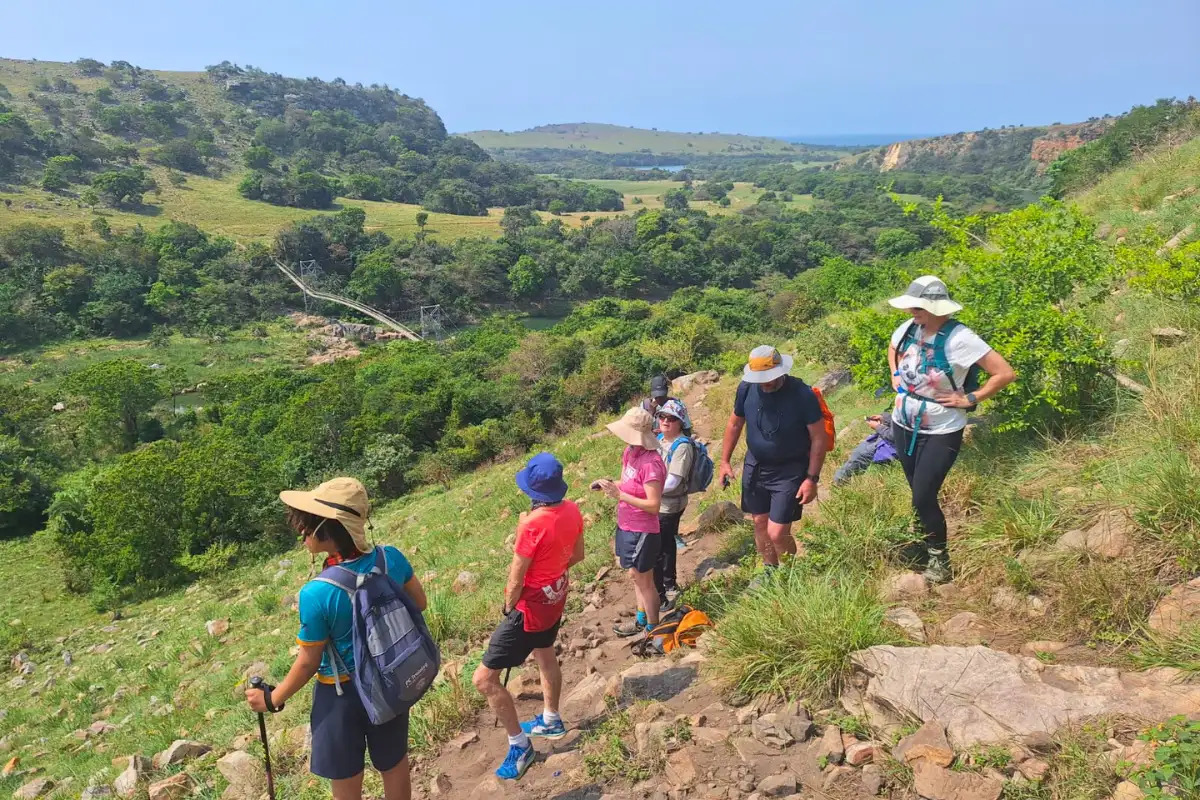
Group of eight hikers with backpacks and sun hats gathered at the Wild Coast Sun ready to begin the Mtentu Ramble guided coastal hike
No, you don't. This is worth being clear about, because a lot of first-time hikers talk themselves out of things they'd be perfectly capable of doing.
You don't need navigation experience. Our guides know every metre of this trail. You follow them. There are no maps to read, no trail markers to find, no decisions to make about which way to go.
You don't need river crossing experience. Every crossing is assessed by your guide before you attempt it. Where conditions require it, we use kayaks. Nobody wades into anything that isn't safe.
You don't need to carry heavy weight. Your accommodation, meals, and equipment are all sorted in advance. All you carry is a day pack with water, snacks, a camera, and a rain jacket.
You don't need camping experience. You sleep in beds every night. There are no tents, no sleeping mats, no cooking over a camp stove.
You don't need special gear. A good pair of walking shoes or trail runners, some comfortable clothing, sun protection, and a rain layer. That's the list. Full details here: What to Pack for a Multi-Day Hike in South Africa →
What makes the Mtentu Ramble beginner-friendly?
The Mtentu Ramble was designed to bring people onto this coastline who wouldn't otherwise have access to it. That shapes everything about how the trail is run.
Local guides. Your guides grew up on this coast. They set the pace, they read the conditions, and they look after the group. If someone is struggling, the guide knows before that person has said anything.
Everything provided. Because all meals are cooked and all accommodation is arranged in advance, there's nothing to worry about except the walking. The logistical burden that makes multi-day hiking daunting for beginners simply isn't there.
Small groups. Maximum 12 people. The guide knows every person in the group by name by day two. If you're finding a section tough, that gets noticed and managed.
Paced days. The daily distances are designed to be achievable. Day one is the shortest. The trail builds gradually as your legs find their rhythm.
Real beds. Sleeping in a proper bed each night rather than on a tent floor makes an enormous difference to how you feel the next morning. Recovery is faster. Energy is better. The experience is just more human.
What is the hardest part of the trail?
Honesty matters here more than a sales pitch.
Day three tends to be the longest. It's typically the day with the most ground to cover, and it comes when your legs are already three days into the trail. Most people find they're more capable than they thought by then. A few find it tough. Your guide is there either way.
River crossings can be confronting. Especially in summer when water levels are higher. The crossings are managed and safe. But if you've never done anything like it before, the first one might require a breath and a step of faith. By the second one you'll be fine.
The sun and heat in summer. Coastal hiking on a hot day, with limited shade in places, is genuinely tiring. Hydration and early starts are the answer. Your guide will manage this.
Soft sand. Some beach sections involve walking through soft coastal sand, which is harder on the legs than firm ground. It's not long-lasting, but it's worth knowing about.
Remote. There are no shops, no clinics, no signal. If something goes wrong, the response is your guide and whatever's in the first aid kit. This is another reason an experienced local guide matters so much. See also: Is the Wild Coast Safe for Tourists? →
Do I need hiking boots or will trail runners do?
Trail runners are fine, and plenty of our guests prefer them, particularly for the beach sections where boots just fill with sand.
What actually matters is not the category of shoe but two things about it: that it is broken in, and that it fits your foot properly. Blisters from new boots are far and away the most common preventable problem we see on this trail, and they are miserable in a way that can take the shine off an otherwise perfect week.
So the honest advice is to wear whatever you already walk in and trust. If that is a pair of boots you have had for years, wear those. If it is trail runners, wear those. What you should not do is buy stiff new boots specially for the trip and arrive having walked ten kilometres in them. Full kit detail is in what to pack for a multi-day hike.
How do you train for a multi-day hike?
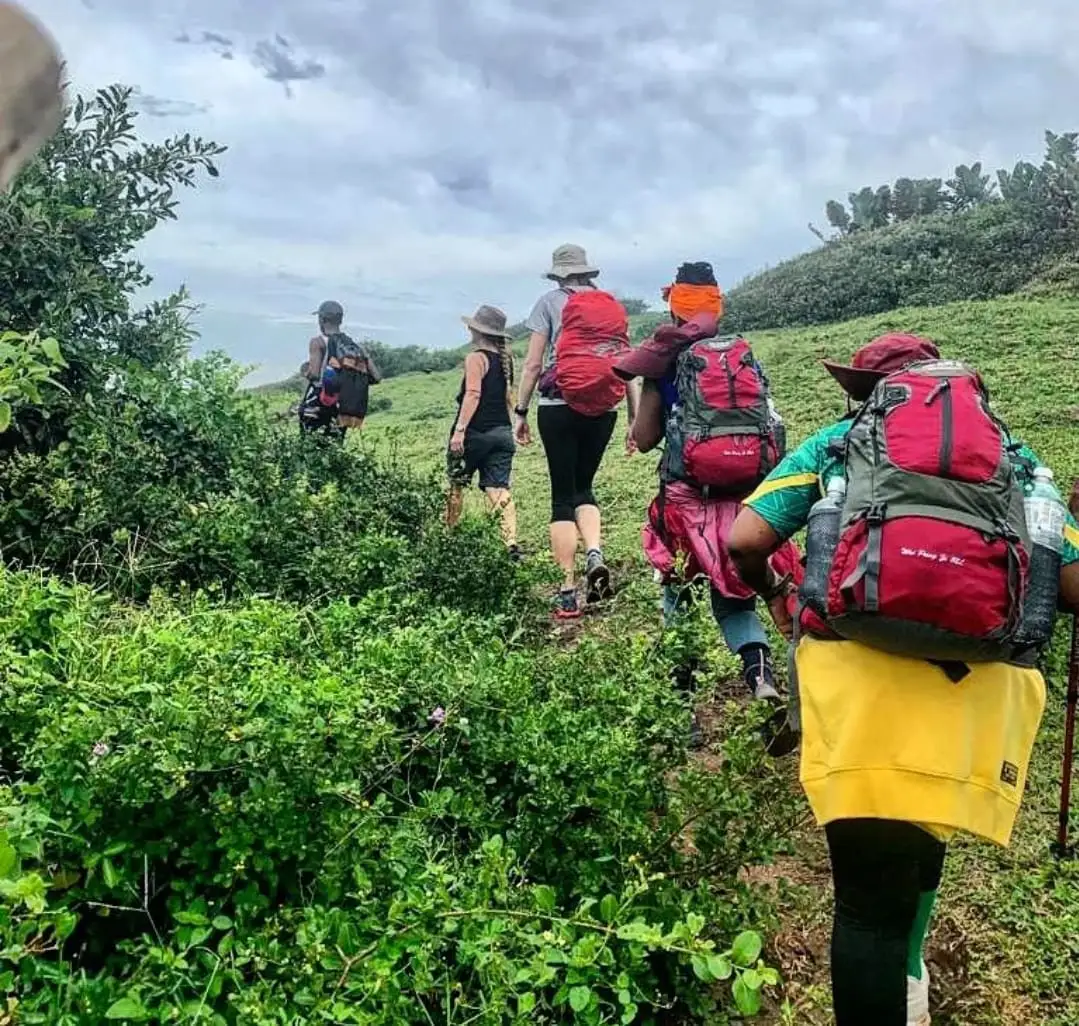
Group of hikers with full backpacks climbing a lush coastal hillside above Sikombe Beach on the Wild Coast
Six to eight weeks of preparation will make a significant difference to how much you enjoy this trail versus just survive it.
Walk on weekends. Start with 5 to 7 km and build to 12 to 15 km over the six weeks. Do it on mixed terrain if possible: grass, paths, soft sand if you can find it.
Walk in the shoes you're bringing. Whatever footwear you plan to hike in, wear it for your training walks. Blisters on day one of the trail are avoidable.
Do back-to-back days. Walking 10 km on a Saturday is not the same as walking 10 km on Saturday and then 10 km again on Sunday. Do at least one or two consecutive-day walks in your preparation period.
Carry your day pack. Get used to the weight and fit of your pack before you arrive. An unfamiliar pack on day one creates problems that shouldn't exist.
Sort your feet. Clip your toenails short before you come. Long toenails on downhill sections are miserable and entirely preventable.
What do first-time hikers say?
We hear a version of the same thing a lot: "I wasn't sure I'd make it and I'm so glad I didn't let that stop me."
The people who struggle on this trail are almost never the ones who worried they weren't fit enough. They're the ones who didn't prepare at all, or who pushed too hard in the first two days and paid for it on day three.
The people who thrive are the ones who arrive with a basic level of fitness, sensible footwear, and a willingness to walk at the pace the trail asks for rather than the pace their ego suggests.
That's not a high bar. Most people clear it without much trouble.
FAQs
What age is suitable for the Mtentu Ramble?
We've had hikers from their mid-twenties to their early eighties complete the trail comfortably, including Gill Tregenna, an 83-year-old world record race walker who completed the trail with her group of tannies aged 76 to 79. Age matters less than fitness. A fit 65-year-old will enjoy this trail far more than an unfit 35-year-old. For children, we'd suggest a minimum age of around 10, and we'd want to discuss the specifics with parents before booking.
Can I do this trail if I have a bad knee?
It depends on the knee and the day. Beach and grassland walking is generally kinder than mountain terrain. We'd recommend speaking to your doctor before booking, and letting us know in advance so we can factor it into the planning. We've had guests with knee issues complete the trail successfully with the right preparation and pacing.
What if I can't finish a section?
It hasn't happened often, but the logistics can be adjusted if someone genuinely can't continue. We'd rather you tell us you're struggling than push through something that puts you at risk. This is another reason small groups with experienced local guides matter.
Is there a minimum fitness test?
No formal test. But we do ask everyone to honestly assess whether they can walk 10 to 12 km in a day on uneven terrain. If the answer is no, we'd rather have that conversation before you arrive than on day two of the trail.
How many people are in a group?
A maximum of 12. Small groups are deliberate: the guide knows every person by name by day two, and if someone is finding a section tough, that gets noticed and managed rather than missed.
---
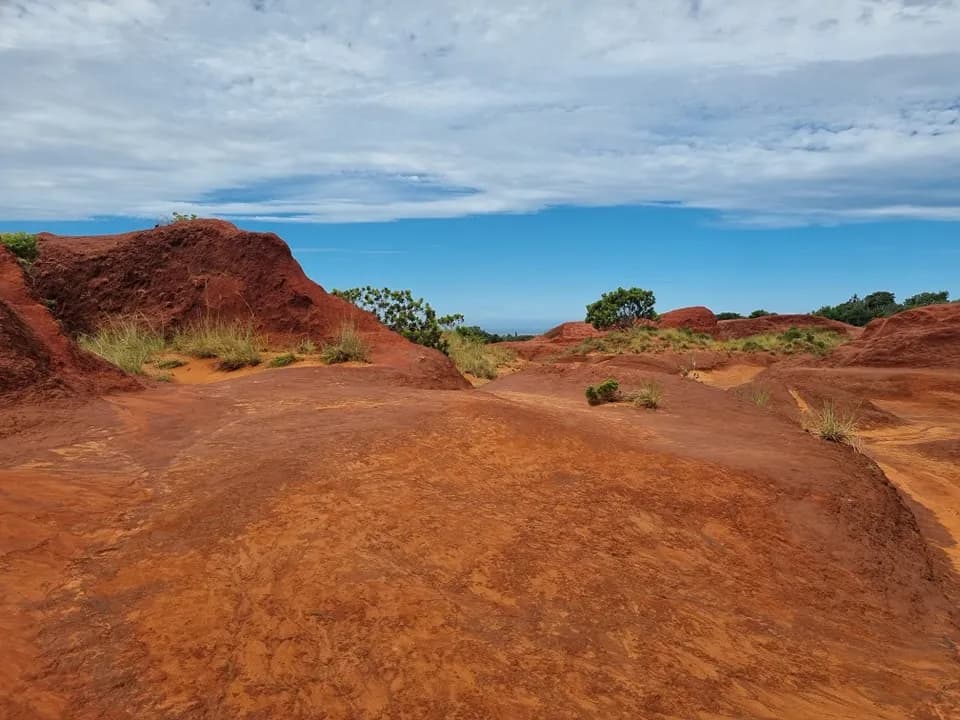
Vivid red iron-rich sand dunes beside the Sikombe River under a blue Pondoland sky Wild Coast South Africa
The Mtentu Ramble is designed to be a genuine adventure that doesn't require you to be a serious athlete. It asks for basic fitness, a willingness to walk steadily for a few hours each day, and an openness to an experience that's unlikely to be like anything you've done before.
If that sounds like you, you're ready.
Not sure when to come? Read: Best Time to Hike the Wild Coast →
Comparing the Wild Coast with the Garden Route? Read: Wild Coast vs Garden Route: Which Should You Choose? →
Ready to Experience This Yourself?
The Wild Coast is waiting. Book your guided hike with Mtentu Ramble and create memories that will last a lifetime.